Scientific Bibliography Observatory – Updated

In 2023, the Steppe Forward Chair created the Scientific Bibliography Observatory on Solar Photovoltaic Energy and Biodiversity, with the goal of providing a repository of scientific literature that facilitates and speeds up access to the most up-to-date knowledge on the compatibility between biodiversity conservation and the development of photovoltaic renewable energy. The peer-review process to which all included articles are subjected ensures the highest quality of the information provided.

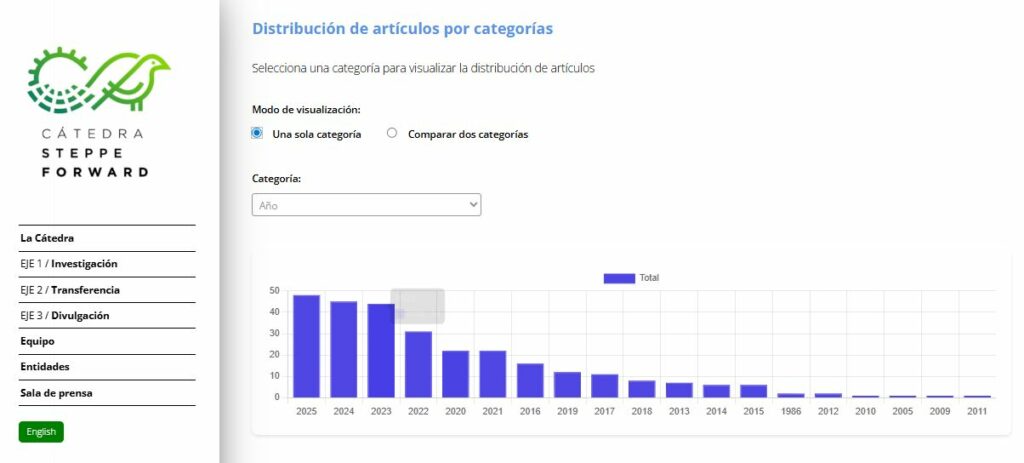
Over the past few months, new scientific articles have been added, bringing the total to 286 bibliographic references available. The collected bibliography focuses mainly on studies conducted in North America, followed by Europe and Asia. Regarding the ecosystem context, most studies have been carried out in desert areas or agroecosystems. In terms of ecosystem components, these are fairly evenly represented, although plants show a slight predominance compared to other components such as soil, birds, or microclimate.

Additionally, a new interactive chart has been incorporated, allowing users to visually summarize the Observatory’s content according to different factors or categories.

captura grafica
captura grafica

For more information and access to the Observatory, please visit:
🔗 https://steppeforward.eu/en/bibliography-observatory/

The 4th Technical Conference of the Steppe Forward Chair explored new ways to address the challenges of integrating photovoltaic energy and biodiversity conservation

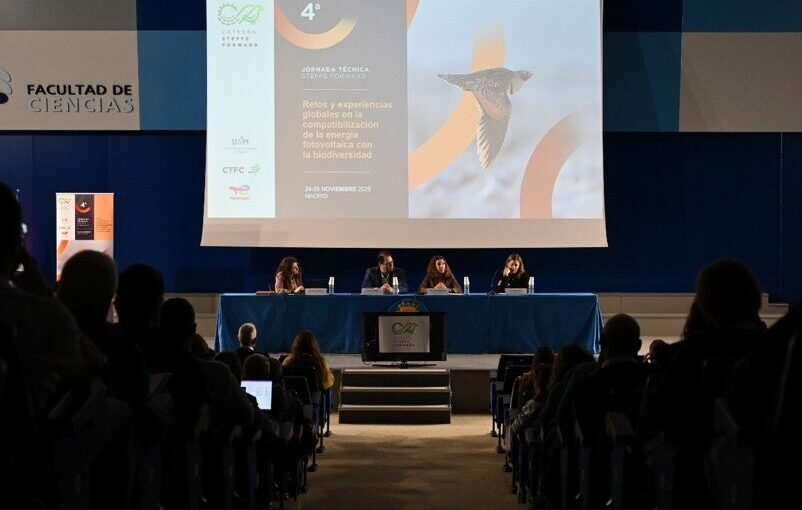
The Steppe Forward Chair held its 4th Technical Conference on November 24 and 25, focused on “Global challenges and experiences in reconciling photovoltaic energy with biodiversity.”

The event, which brought together nearly 300 participants, convened national and international experts, academic professionals, public administrations, and companies linked to the energy sector at the Aula Magna of the Biology Building at the Faculty of Sciences of the Autonomous University of Madrid.

The program was organized into three thematic areas: current methodologies for environmental impact assessment, management measures within solar facilities, and compensatory actions outside operational perimeters. Throughout the two-day conference, plenary sessions, presentations, and discussion spaces were held, allowing attendees to learn about recent research and real-world examples in diverse contexts on how to reconcile photovoltaic energy and biodiversity conservation.

The institutional opening was led by Irene Aguiló Vidal, Director General of Biodiversity and Forest Management of the Community of Madrid, along with representatives of the entities promoting the Chair.

In her remarks, Irene Aguiló Vidal emphasized: “We have collaborated with the founders of the Chair from the beginning, both in identifying the main impacts of photovoltaic deployment in Madrid and in designing our agri-environmental program, through which we organize all the compensatory actions linked to this development. That is why I want to thank the companies developing projects in Madrid and the land stewardship organizations for their efforts in starting to work even before laying the first stone. This anticipation allows us to have an advanced understanding of the territory and ensures that, when developments begin, actions can be implemented immediately and yield results relatively soon.”

Meanwhile, Borja Guzmán, Director of Asset Management and Operations at TotalEnergies Renewables Spain, stated that “at TotalEnergies, developing our projects responsibly is a true hallmark, and an initiative like the Steppe Forward Chair is essential to verify that we are on the right path and that the measures we implement are the best available. The key to its success lies in its multidisciplinary approach, which makes it possible to generate scientific knowledge, protocols, and global action models for the academic, corporate, and public management spheres.”

Rocío Schettini del Moral, Director of the Autonomous University of Madrid Foundation (FUAM), said in her welcome to attendees that “the 4th Steppe Forward Conference represents a privileged space to advance dialogue on an energy transition compatible with the protection of agro-steppe biodiversity. At the Autonomous University of Madrid Foundation, we are proud to support this initiative, convinced that scientific knowledge and collaboration between entities are key factors in achieving the Chair’s objective: reconciling renewable energy development with the conservation of our ecosystems.”

Roser Maneja, Research Director at the Forest Science and Technology Centre of Catalonia (CTFC), highlighted “the great strategic value of this conference as a meeting point for public administrations, the energy sector, environmental consulting, and the scientific community. The Steppe Forward Chair is currently one of CTFC’s strategic projects, not only because of its relevance and scientific contributions, but also for its public-private collaboration model and for working through an inter- and multidisciplinary perspective. The Char is a global pioneer in its field and aims to contribute scientific knowledge to improve decision-making processes in energy transition based on solid sustainability criteria. Without a doubt, one of the greatest contributions science can make in these complex times of climate emergency.”

The three sponsoring organizations highlighted the fundamental role that the Steppe Forward Chair’s findings have played so far and reaffirmed their commitment during the renewal ceremony held before the official opening of the conference.

The presence of international specialists brought a comparative perspective on the relationship between solar energy and the conservation of sensitive fauna and habitats. Stefania Charisiadou, Nature Conservation Policy Officer at the European Commission, indicated that “accelerating the deployment of renewable energies is vital, but we must do so in a way that respects, protects, and—when possible—enhances biodiversity. If we use our existing legislative frameworks for renewable energy and nature wisely and strategically, we can generate real synergies.”

Meanwhile, Dr. Todd Katzner, researcher at the United States Geological Survey (USGS), explained that “solar energy is expanding rapidly worldwide. This provides a unique opportunity for research that can help understand its potential environmental impacts and mitigation options.”

Finally, Bertrand Schatz, researcher at the French National Centre for Scientific Research (CNRS), emphasized that “pollinators are experiencing a massive decline in Europe, primarily due to pesticides and habitat degradation. Photovoltaic plants can pose an additional threat, although there are solutions to avoid, reduce, and compensate for their impacts.”

The fourth edition of the Technical Conference concluded with a shared takeaway: the need to continue creating spaces where science, public administration, and the energy sector can exchange data and experiences that facilitate the development of photovoltaic projects with greater attention to biodiversity.

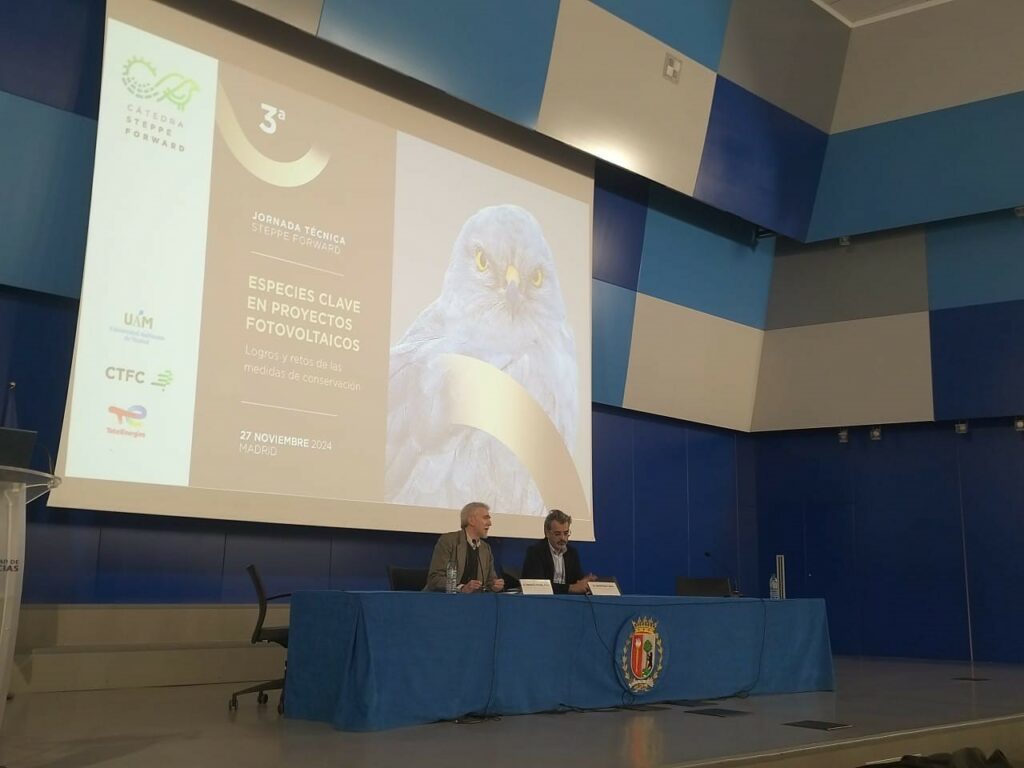
The Third Edition of the Technical Day of the Chair becomes a benchmark event with over 300 attendees

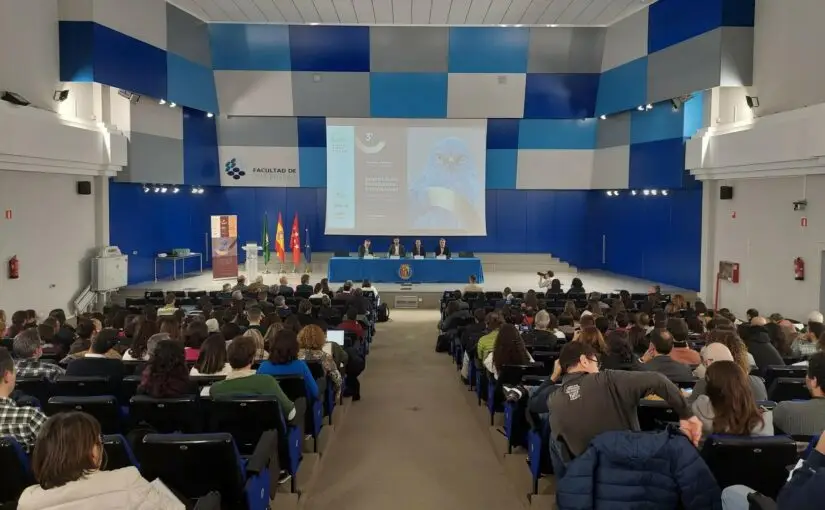
The Steppe Forward Chair, promoted by the Autonomous University of Madrid (UAM) through its foundation (FUAM), the Forest Science and Technology Centre of Catalonia (CTFC), and the multi-energy company TotalEnergies, held its third Technical Day in Madrid. With more than 300 attendees, it has established itself as a leading event for knowledge transfer on the compatibility of photovoltaic solar projects with biodiversity conservation.

Under the topic “Key species in photovoltaic solar projects: Achievments and challenges and of the conservation Measures,” the conference focused on key bird species during the implementation of solar projects. Several experts presented specific case studies on the management, monitoring, and effectiveness of conservation measures for these species which are frequently addressed in environmental impact statements. These species include the Bonelli’s eagle, Montagu’s harrier, Dupont’s lark, Great bustard, Lesser kestrel, and Little bustard.

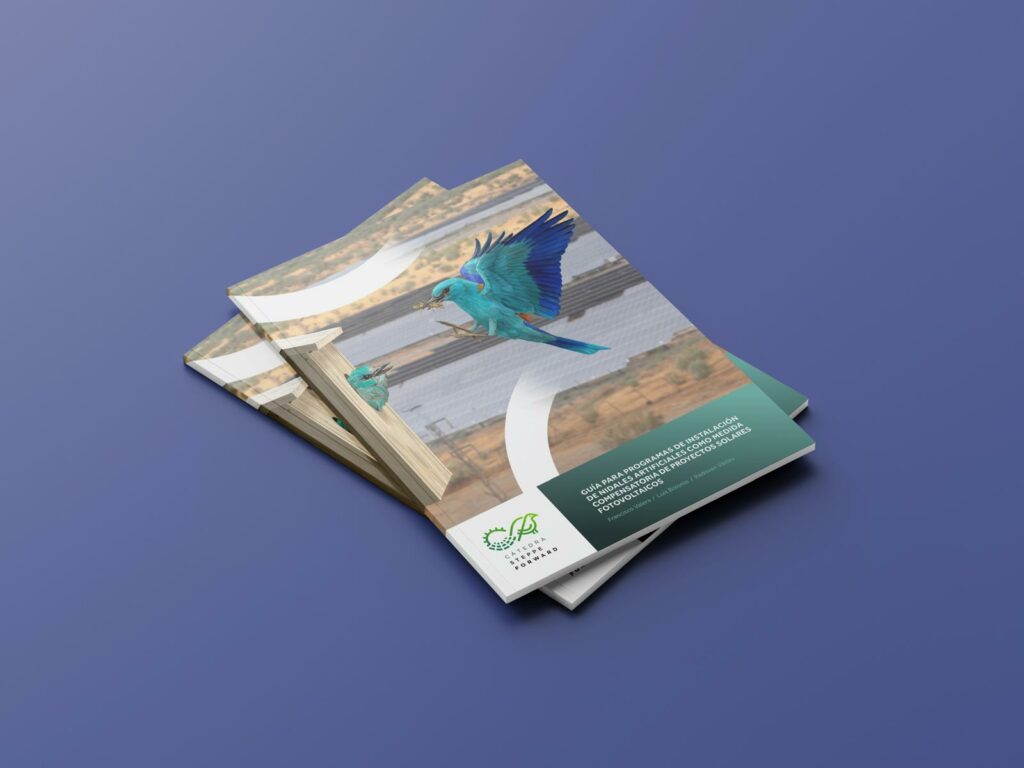
A highlight of the event was the presentation of the “Guide for the Implementation of Artificial Nest Programmes as a Compensatory Measure for Photovoltaic Solar Projects,” created by Francisco Valera Hernández from EEZA-CSIC, Luís Bolonio from CEBIME and Radovan Václav from the Slovak Academy of Sciences. This guide is one of the outputs developed by the Chair. The Guide can be downloaded here (Spanish version).

publicacio catedra

Opening and Key Remarks
The event was opened by Iván Manzanares, Director of the Center for Innovation Support and Knowledge Transfer (CAITEC) at FUAM, who emphasized “the importance of generating and disseminating scientific knowledge so that decision-making is based not only on data but also on science.”

Next, Gerard Bota, researcher at the Forest Science and Technology Centre of Catalonia and representative of one of the Chair’s founding entities, remarked, “Through the Chair, we continue to promote initiatives that bring scientific knowledge closer to stakeholders through transfer and debate spaces like this annual conference, or applied technical products like the guide presented today.”

Jordi Torres, General Director of Development for TotalEnergies Renewables Spain, highlighted, “It is immensely satisfying to see the Chair becoming a benchmark initiative to help academia, the energy sector, and public administrations address the environmental challenges posed by renewable energy development. At TotalEnergies, it’s not enough to generate more reliable, affordable, and sustainable energy—we must also hold ourselves to the highest standards and remain acutely aware of our environmental and social responsibilities.”

The institutional opening was concluded by Fernando Magdaleno, Deputy Director-General for Terrestrial and Marine Biodiversity at the Ministry for Ecological Transition and the Demographic Challenge (MITERD). He stated, “A fair, equitable, and inclusive ecological transition is an absolute necessity, requiring participation from all sector stakeholders. Collaboration among administrations, companies, and social organizations is fundamental. Scientific knowledge and the involvement of local communities are key to building trust in environmental policies and renewable projects, providing concrete tools that generate clear benefits for environmental and human health.”

Contributions from Academia and Industry
The conference also included participation from members of various universities, such as Santi Mañosa and Nicolás Ordax from the University of Barcelona, Julia Zurdo from the Autonomous University of Madrid, as well as members of CSIC, including Beatriz Arroyo and David Serrano, and representatives from the private sector like Laura Sánchez, Environmental Manager at Cobre Las Cruces, and Eladio García de la Morena from Biodiversity Node.

catedra 2 b

Closing Debate
The session concluded with a panel discussion moderated by Julia Gómez-Catasús from the Department of Ecology and CIBC-UAM, as well as a researcher for the Steppe Forward Chair. The panel featured the program’s speakers, who addressed questions from the audience.

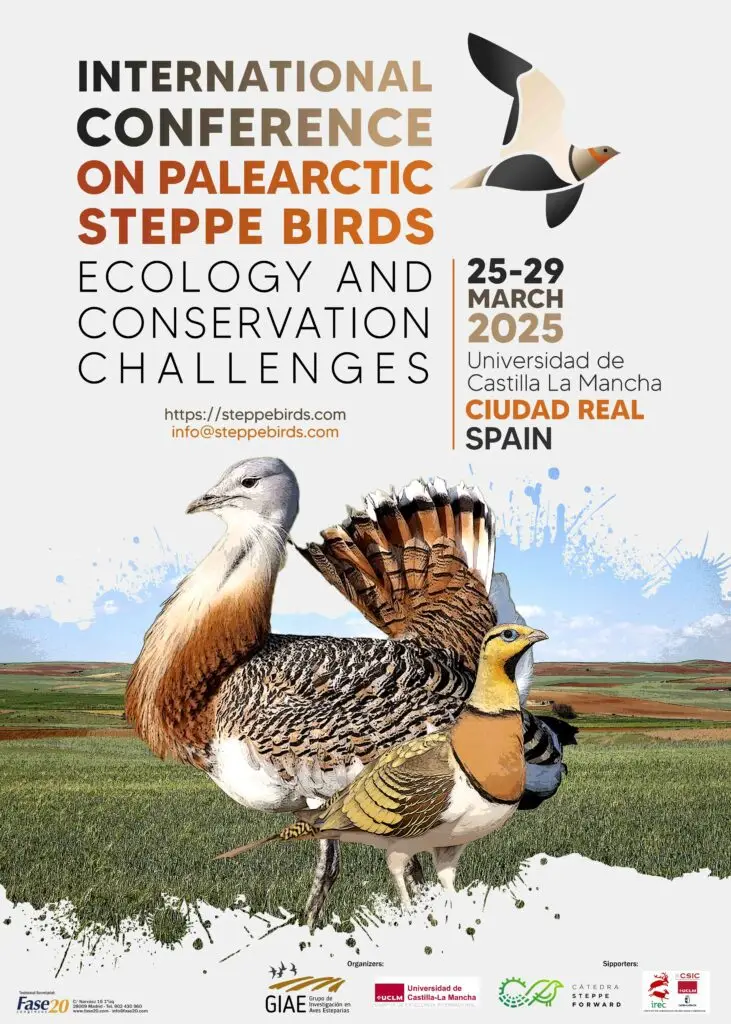
The Steppe Forward Chair supports the organization of the International Conference on Palearctic Steppe Birds

The Steppe Forward Chair supports the organization of the International Conference on Palearctic Steppe Birds

The Palearctic steppes are one of the most extensive terrestrial ecosystems in the world, but also one of the most threatened. Intensification, the abandonment of traditional land uses and the development of new ones have endangered these ecosystems and the bird community that inhabits them. Understanding the ecological requirements of the species and the factors that threaten their populations, as well as understanding the current and future conservation challenges are crucial for their conservation.

To address these challenges, the “International Conference on Palearctic Steppe Birds: ecology and conservation challenges” will be held in Ciudad Real (Spain) from 25 to 29 March 2025. The conference aims to bring together researchers, students, practitioners and managers to share their experiences and the results of their latest research on the ecology and conservation challenges of Palearctic steppe birds, and to promote international scientific cooperation. The conference will include invited talks, oral presentations, poster sessions and workshops.

Given the Chair’s involvement in the study and conservation of steppe species, typical of the areas where the photovoltaic plants are installed, it has become involved in the organisation of the conference by providing financial support. The conference is organised by the Grupo de Investigación en Aves Esteparias de la Península Ibérica (GIAE) and the University of Castilla-La Mancha, and is also supported by the Instituto de Investigación en Recursos Cinegéticos.

20241016 ICPSB Cartel logosOK
Contact us
Access our contact form